Author: Ian

  • Beatrix Potter

    Beatrix Potter

    You may not realise it but Beatrix Potter was the JK Rowling of her day. When she died on 22 December 1943, aged 77, she left £211,636, a value of about £12,600,000 in today’s money. She also bequeathed over 4000 acres of land to the National Trust, worth about £28,000,000 at today’s value. She also left 16 farms and cottages together with herds of cattle and flocks of Herdwick sheep. The copyright of all her works went firstly to her husband and then onto her favourite nephew, Norman Warne. Her legacy can be explored in her old farmhouse at Hill Top in Hawkshead through her illustrations at the Beatrix Potter Gallery or brought to life at the World of Beatrix Potter Attraction.

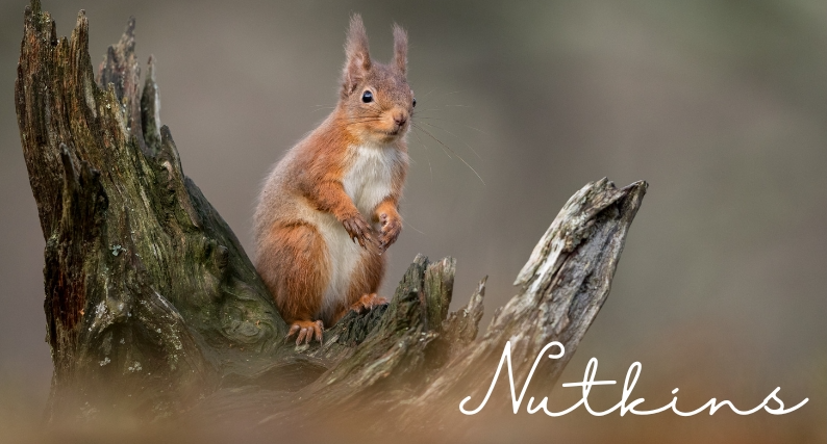
    Beatrix Potter was born in South Kensington, Middlesex in 1866. She was aged 11 when she first visited the lakes with her family. She already had an interest in animals but it was from this visit that her interest in the Lake District began. It was during these family holidays, that the drawings she created were the inspiration for her most famous characters – Peter Rabbit, Benjamin Bunny, Squirrel Nutkin and more – as well as many of the locations in her books.

    On one of the family trips to the Lakes, they stayed at Wray Castle and did quite a bit of entertaining. Beatrix became friends with a local vicar, Cannon H. Rawnsley of Wray Church. Cannon H. Rawnsley, who had Tennyson, Ruskin and Browning within his circle of friends, would be a huge influence on Potter. It was Rawnsley, who would later encourage Beatrix to publish her first book The Tale of Peter Rabbit. He influenced Potter in other ways, later on in his life, he become one of the co-founders of the National Trust, in the battle to preserve the natural beauty of the Lake District. Although she holidayed in many other places, particularly Scotland, she remained in contact with Cannon H. Rawnsley. On returning home to London from her holidays she would make greeting cards of her pictures and eventually began making a book.


    At the age of 27, Potters tried to publish The Tale of Peter Rabbit and sent it to Frederick Warne, a well-known publisher of children’s books. But it was returned by Warne and many other publishers also rejected it. In 1901 she found a printer and self-published 250 copies of the book for a total cost of £11. In 1902 it was picked up by Frederick Warne & Company who published it commercially with great success. In the next 20 years, she published a further 22 additional books, beginning with The Tailor of Gloucester (1903), The Tale of Squirrel Nutkin (1903), and The Tale of Benjamin Bunny (1904). The tiny books, which she designed so that even the smallest children could hold them. This was combined with simple prose, concealing dry North Country humour, with illustrations in the best English watercolour tradition.

    Despite strong parental opposition, she became engaged in 1905 to Norman Warne, the son of her publisher, During the summer of 1905 and a few weeks into their engagement, he fell ill and died of leukaemia. After his sudden death, she spent much of her time alone at Hill Top, a small farm in the village of Sawrey that she had bought with the proceeds of a legacy and the royalties from her books. In 1909, with her income beginning to grow, she bought Castle Cottage, a property just across the road from Hill Top, using solicitors at the W. Heelis offices in Hawkshead which is now the National Trust’s “Beatrix Potter Gallery”.

    In the 19th Century, there was no formal education for girls and Victorian values also precluded her from becoming a farmer, however, in 1913 she married her solicitor, William Heelis, and spent the last 30 years of her life extending her farm property portfolio and breeding Herdwick sheep. In 1923 she purchased Troutbeck Park Farm and the Monk Coniston Estate in 1930, which is situated a couple of miles northeast of Coniston.

    Hilltop now had a farm manager who lived at one end of the property, and the part in which Beatrice lived, was left empty and her possessions remained exactly as she left them. This later became her personal museum with her possessions again, still as she left them. Beatrix was a passionate conservationist and as a farmer, she became best known for the breeding of Herdwick sheep, Lakeland’s own breed. She would talk more about the sheep than the books she wrote. She attended country shows and exhibitions showing and judging them.

    Sadly, in old age, her sight deteriorated and she lost much of her vision. The last few stories she wrote were written for publication in the United States. Her critics say they did not match her earlier work in style or craftsmanship. She died from pneumonia just before Christmas in 1943. She was cremated, and her ashes were scattered by her husband William in New Sawrey at the south end of Esthwaite Water.

  • Alfred Wainwright

    Alfred Wainwright

    One should always have a definite objective, in a walk as in life – it is so much more satisfying to reach a target by personal effort than to wander aimlessly. An objective is an ambition, and life without ambition is … well, aimless wandering.  A Coast to Coast Walk Introduction p iv

    Although the Lake District skyline and landscape haven’t altered a great deal for the last 12,000 since the last ice age, it was during the following Neolithic period that saw the biggest change as the world started to warm up. Consequently, 7,000 years ago, much of Cumbria was covered by plants, woods, and forests. Between then and circa 2-2,500 years ago, the late Neolithic cave dwellers started to clear the trees and the land to create permanent homes, plant crops, and allow easier hunting of wild animals. Less than seventy-fifty years ago, between 1955 and 1966 Alfred Wainwright gifted us with his seven-volume hand-drawn and detailed Pictorial Guide to the Lakeland Fells. There are 214 fells in the Lake District and they are often called ‘The Wainwrights’, it has become the go-to and standard reference work.

    Alfred Wainwright was born in Blackburn in 1907 and died in Cumbria in 1991. He was an accountant, walker, writer, illustrator, and cartographer. During his lifetime he did much for the Lake District, and clearly, his biggest contribution was his Pictorial Guides written and drawn by Wainwright himself, a copy of which sits on my bookshelf and it was this collection for which Wainwright earned his MBE.

     Wainwright was born in relative poverty and it wasn’t until the age of 23 that he was able to visit the Lake District for the first time. He travelled by bus from Blackburn to Windermere with his cousin. On their arrival, they walked the circular walk from Windermere to the viewpoint at Orrest Head (783’) It was the view from the top that proved to be a turning point in his life. He said later,

    It was a moment of magic, a revelation so unexpected that I stood transfixed, unable to believe my eyes. I saw mountain ranges, one after another, the nearer starkly etched, those beyond fading into the blue distance. Rich woodlands, emerald pastures, and the shimmering waters of the lake below added to a pageant of loveliness, a glorious panorama that held me enthralled. I had seen landscapes of rural beauty pictured in the local art gallery, but there was no painted canvas; this was real. This was the truth. God was in his heaven that day and I a humble worshipper. Ex-Fellwanderer (1987).

    In 1941 Wainwright realised his ambition and moved to the Lakes when he secured a post in the Borough Treasurer’s Office in Kendal where he lived until his retirement in 1967. It was over this period that Wainwright explored the hills and mountains, climbing to many of their summits. He began work on his Pictorial Guides in 1952 which was an idea that he had been slowly developing for several years. The first page completed for his guide was the ascent of Dove Crag from Ambleside. This was the start of a literary career that lasted for over forty years until his death in January 1991.

    The influence of Wainwright’s Lake District guides cannot be understated. Over a forty-year period, Wainwright managed to publish over fifty books. He also contributed forewords, introductions or drawings to a further 28 books. In 1968 Wainwright curated and wrote the Pennine Way Companion and in 1973 he created and published The Coast to Coast walk, (C2C) one of the most popular long-distance walks in the country from St. Bees in Cumbria to Robin Hood’s Bay in Yorkshire. Whilst I’ve only completed less than half of the 214 Wainwrights, the C2C is close to my own heart as I’ve cycled it five times.

    In my latest book Grief and Other minds (2022), I’ve included an essay about the growth of tourism from the 18th Century and in particular its attraction and influence on the writers and artists that have trickled here over the last few hundred years. The philosophy, creativity, and ideals that these great minds brought to the Lakes are still very much alive today. They drew and wrote about the unbound wilderness that stretches beyond the horizon that offers an unlimited sense of freedom, and a landscape beautiful in both the sunshine and rain These people and their contributions will forever be a part of the Lake District, and by following in their footsteps, you can really begin to understand how these historical figures were inspired. The popularity of the Lake District has boomed in modern times, and much of that attraction can firmly be put down to the prolific output from Alfred Wainwright.

    Wainwrights dying wish to scatter his ashes on a favourite mountain of his was fulfilled by his second wife Betty. Wainwright’s final resting place is on Haystacks, by the quiet waters of Innominate Tarn.

  • Samual Taylor Coleridge

    Samual Taylor Coleridge

    [et_pb_section fb_built=”1″ admin_label=”section” _builder_version=”4.16″ global_colors_info=”{}”][et_pb_row admin_label=”row” _builder_version=”4.16″ background_size=”initial” background_position=”top_left” background_repeat=”repeat” global_colors_info=”{}”][et_pb_column type=”4_4″ _builder_version=”4.16″ custom_padding=”|||” global_colors_info=”{}” custom_padding__hover=”|||”][et_pb_text admin_label=”Text” _builder_version=”4.16″ background_size=”initial” background_position=”top_left” background_repeat=”repeat” global_colors_info=”{}”]

    Coleridge was inspired and drawn to the Lake District by his friend William Wordsworth, who was born in Cockermouth. Coleridge lived at Greta Hall in Keswick with Robert Southey from 1799 until 1804. During his time there he walked considerable distances and is the first recorded person to descend Scafell Pike via the dangerous rocky wall, Broad Stand. Today, Greta Hall is a Bed and Breakfast and Self-Catering accommodation. Tourists can stay in ‘The Coleridge Wing’, a two-bedroom self-catered apartment, including Coleridge’s former study.

    Samuel Taylor Coleridge, English poet, literary critic, and philosopher, was a founding member of the British Romanticism movement. His friendship with Cumbrian poet, William Wordsworth, would lead to the creation of some of the finest examples of poetry in the English literary canon. Coleridge met William Wordsworth in 1795 while visiting Somerset, the two poets provided great inspiration to each other. Soon after, Coleridge wrote his two most famous works, The Rime Of The Ancient Mariner, and Kubla Khan. Coleridge composed the symbolic poem Kubla Khan, written about the Mongol emperor Kublai Khan and his legendary palace at Xanadu and — as Coleridge himself claimed — as a result of an opium dream, He also composed the Lyrical Ballads with William Wordsworth contributing four of the twenty-three poems in the collection. In 1799, Coleridge followed William and Dorothy Wordsworth to the Lake District. Together in the company of Wordsworth and Robert Southey, he would become known as one of the Lakes Poets. Wordsworth and Southey were captured and enthralled by the natural beauty of the Lake District, but Coleridge had a darker view, perhaps driven by his unhappy marriage and an addiction to an opiate called Kendal Black Drop, and his health deteriorated further. This may also account for many of his poems left unfinished, yet he is still considered one of the most influential poets of the era. The Rime Of The Ancient Mariner is a staple of English Literature studies in schools, colleges, and universities. Furthermore, Coleridge enjoyed creating new words and phrases, and many of his creations are still very much in use today, including ‘soulmate’, and ‘suspension of disbelief.’

    Samuel Taylor Coleridge, the son of the Reverend John Coleridge, was born in Devon in October 1772, the youngest of fourteen children. As a child, Coleridge was an avid reader, and when his father died in 1781, Coleridge was sent to Christ’s Hospital school, where he studied literature and wrote poetry. It was here that the beginnings of the mental illness that would plague him throughout his life began to manifest, first as feelings of loneliness and anxiety. By the time he was old enough to attend Jesus College, Cambridge, where he met lifelong friend Charles Lamb, he was suffering from chronic depression.

    In his third year at Cambridge, he was struggling financially and enlisted as a dragoon in London under the assumed name of Silas Tomkyn Comberbache. However, when discovered, he was bought out by his brothers and sent back to Cambridge. The intellectual and political turmoil surrounding the French Revolution had set in motion intense and urgent discussions concerning the nature of society. This inspired Coleridge to establish a small society that should organize itself and educate its children according to better principles than those obtained in the society around them. A chance meeting with the poet Robert Southey who held similar philosophical views led the two men to plan a pantisocracy, setting up a community by the Susquehanna River in Pennsylvania. This philosophy led to Coleridge marrying Sarah Fricker in 1795, who was the sister of Edith Fricker and Southey’s wife. This marriage, despite producing four children, was never happy, being the result of social convention and convenience rather than love, and added to Coleridge’s mental health difficulties. Coleridge spent the next few years building his career as a writer. During this period, however, Coleridge’s intellect developed in a different direction as he embarked on an investigation of the make-up of the human mind. This led to Wordsworth and Coleridge travelling to the Continent together, where Coleridge spent most of the trip in Germany, studying the philosophy of Immanuel Kant, Jakob Boehme, and G. E. Lessing.

    They returned in 1800 and 1802, he published the last and most moving of his major poems, Dejection: An Ode. He left the Lakes for Sicily and Malta in 1804, leaving his family behind, and never lived with them again. He worked for a time as Acting Public Secretary of Malta under the Commissioner, Alexander Ball. His opium addiction began to take over his life: he officially separated from his wife in 1808, he quarrelled with Wordsworth in 1810, and lost part of his annuity in 1811.

    In later years, Coleridge lived in London, giving public lectures concerning literary criticism.
    He put himself under the care of Dr. Daniel in 1814 and finally moved in with Dr. Gilman in Highgate, London. For the next 18 years, the doctor managed to keep Coleridge’s demon under control. Coleridge died on 25 July 1834 as a result of heart failure compounded by an unknown lung disorder, possibly linked to his use of opium.

    Coleridge was one of the most important figures in English poetry. He was known by his contemporaries as a meticulous craftsman who was more rigorous in the careful reworking of his poems than any other poet. His influence on Wordsworth is particularly important because many literary critics have credited Coleridge with the very idea of ‘Conversational Poetry’, which is the idea of utilising common, everyday language to express profound poetic images and ideas for which Wordsworth became so famous.

    [/et_pb_text][/et_pb_column][/et_pb_row][/et_pb_section]

  • William Wordsworth – 7 April 1770 – 23 April 1850

    William Wordsworth – 7 April 1770 – 23 April 1850

    [et_pb_section fb_built=”1″ admin_label=”section” _builder_version=”4.16″ global_colors_info=”{}”][et_pb_row admin_label=”row” _builder_version=”4.16″ background_size=”initial” background_position=”top_left” background_repeat=”repeat” global_colors_info=”{}”][et_pb_column type=”4_4″ _builder_version=”4.16″ custom_padding=”|||” global_colors_info=”{}” custom_padding__hover=”|||”][et_pb_text admin_label=”Text” _builder_version=”4.16″ background_size=”initial” background_position=”top_left” background_repeat=”repeat” global_colors_info=”{}”]I’m not a poet, but just the fact that I associate Dominic with Bowscale Tarn, therefore Wordsworth, meant I needed to try. I wrote, Thoughts on a Cumbrian Lad at Bowscale (Appendix 1). Wordsworth himself was no stranger to the early death of a child. During his marriage to Mary Hutchinson, he had five children between 1803 to 1810. Three of the children predeceased both parents, Thomas aged six, Catherine aged three, and Dora aged forty-three. When Dora died in 1847, Wordsworth was devastated and stopped writing poetry. This contradicts my belief that writing and creativity can help us through grief. On the other hand, for Wordsworth, it might just have been the final straw. Dora died only three years before his own death aged eighty.

    It was Catherine however who had the biggest impact on Wordsworth emotionally and I would argue his creativity. Surprised by Joy (Appendix 2) is Wordsworth’s heart-breaking sonnet which begins in joy and ends in sorrow. At the beginning, following Catherine’s death, the first time he experiences joy Wordsworth is surprised by a feeling he never expected to experience again. He quickly turns to share it with someone, but that someone has gone. “I turned to share the transport—Oh! with whom but thee, long buried in the silent Tomb.” I pick up the phone to call Dom all the time, only to realise he isn’t there anymore, even though his number is still is in my mobile. How could I even contemplate deleting it?

    Wordsworth too realises that Catherine isn’t there and won’t ever be there again.  He is acutely aware of his grief. It sweeps over him, blotting out any hint of earlier joy. He seems to experience the shock of loss all over again just as it had consumed him when he first heard the news of her death. Surprised by Joy ends with the realisation that his joy would always be swept away in grief because no amount of time could ever bring back to him that “heavenly face” that he was missing so dearly.

    Poets seem to be well equipped to capture their grief in their words. Two Hundred years earlier in 1603, Ben Johnson wrote his elegy On My First Son (Appendix 3) following the death of his seven-year-old boy from the plague. In the poem, Johnson struggles to answer the questions that Wordsworth and I also couldn’t answer either: Can he recover from this hammer blow? And if he can, what could possibly compensate him for the loss? The death of Dora stops Wordsworth from writing. After Benjamin dies Johnson vows never to love anything ever again. I find myself at the edge of Bowscale tarn looking for the impossible, improbable immortal fish. Again, I’m not a poet. I’m not famous. How can I write meaningfully and passionately about my son’s death? What clever, or even weaselly words, can I weave together that will bring him back to life?

     [/et_pb_text][/et_pb_column][/et_pb_row][/et_pb_section]

  • Dominic and The Lake District – Taken From Smiler

    Dominic and The Lake District – Taken From Smiler

    The Lake District has been a county that attracts poets, painters, writers and homegrown fox hunters that have songs written about them. For example, ‘D’ye Ken John Peel?’ about John Peel, a famous eighteenth-century Cumbrian huntsman. Like Dominic, Peel was from the Caldbeck area, a likeable rogue and a man prone to dissipation. His friend and neighbour John Woodcock Graves (1795–1886), wrote the lyrics to the song in the Cumbrian dialect and set them to the tune of a traditional Scottish song, called Bonnie Annie. Like Peel, Dominic also had poems and songs written about him.

    Graves travelled to Tasmania from Caldbeck, where he lived out the rest of his life. I have the only remaining oil painting of him, but our paths cross on a personal matter. His eldest son John, a successful barrister, died as Dom did, before his father. I feel Grave’s pain almost one and half centuries later, I can see it in his portrait’s eyes.

    The other thing that John Peel and Dominic, have in common is that they are both buried in St Kentigern’s Church, Peel in Caldbeck and Dom in Castle Sowerby, the parishes where they were born. Sadly, both of them have had their graves vandalised. Peels was damaged by anti-hunt protesters, one hundred and fifty years after his death, and Dom’s by an unknown assailant between the 4 – 6 May 2015, eighteen months after his death.

                                                                                                                                                                                                                                                      FFS dad you no as well as I do who did it…

    As is the Christian tradition, Dom’s grave faces to the east, so the Northern Massif landscape is behind him. He hasn’t turned his back on his beloved hills, in fact just the opposite, his grave basks in the sunrise from the east above Penrith and falls into shadow as the sun sets on the other side of High Pike and Caldbeck. It’s a passage of the sun he knows well, growing up at Vicargate two fields away from his grave. The church was founded by St Kentigern in the sixth century, or Mungo, as he was also known. He had a major influence on large areas of Cumbria, digging wells to baptise the hill dwellers and building several churches on his missionary journey from Scotland to Wales.

    Legend has it, that Kentigern converted Merlin (Myrddin) to Christianity during his time in the Scottish Borders, as depicted in the stained-glass window in a church in Tweeddale

    One of Dom’s favourite places to visit was Bowscale Tarn, an isolated hamlet named after St Mungo, nestled between Mosedale and Mungrisdale. As a man, he was often up there with Lucy. As a teenager, Dom worked at the Mill Inn, the only pub in Mungrisdale.

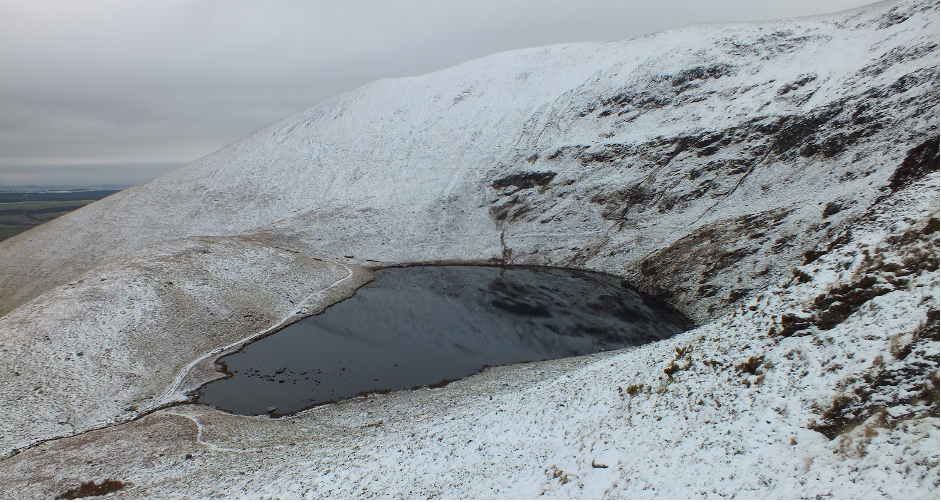
    The tarn is a dark, brooding place. It’s 56 feet deep, but to Dom, it was an oasis of solitude and serenity. According to folklore, two immortal fish live in the tarn and it’s these fish that appear in Wordsworth’s 1888 poem, Song at the Feast of Brougham Castle.

    Dom would mention the tarn in his texts and take pictures of Lucy on his phone fetching the sticks and tennis balls that he’d thrown into the enigmatic water.

                                                                   there u go agen

                                       i don’t even no who this wordsworth gadg is

    but ur right tho its the best place

    lucy loved the water

    According to Cumbrian legend, Mungo’s mother was a princess, the daughter of King Lleuddun who ruled the lands of Lothian in Scotland. She became pregnant after being raped by the son of Urien, the King of Rheged (c.590). In a twisted act of early medieval honour killing, her father had her thrown off Traprain Law, a hill in east Lothian.

    She survived the fall and made her way across the River Forth to Fife. Mungo was born and brought up by Saint Serf who was ministering to the Picts. It was Serf who gave him his name, Mungo, which means ‘Dear Friend’. An anti-Christian movement in Strathclyde made it difficult for Mungo and he left the area and travelled to Wales, via Cumbria.

    After a pilgrimage to Rome, he returned to Glasgow where a large community grew up around him. In old age, it is said that Mungo became very weak and was so feeble that his chin had to be kept in place with a bandage. He died in his bath.

  • René Descartes and Other Minds

    René Descartes and Other Minds

    When you’re grieving you literally leave your mind. In my case to the point of questioning what is going on in other people’s minds. “Don’t you know Dom is dead? What the fuck is up with you??” It’s insane, but you start to think that no one else cares or even has any thoughts. Other Minds is a 20th Century philosophical debate that argues if you don’t know what other people are thinking, do they actually have any thoughts or do they even exist? Other minds can be traced back to Descartes, a 16th Century French philosopher, and was based on nothing more than skepticism. When you have lost a child, you are skeptical about everything, which drove me to try to understand why people didn’t feel like I did.